Disclosure: This article may contain affiliate links. We may earn a commission at no additional cost to you.
Table of Contents
ToggleHyperX Neurable Brain-Tracking Headset: Can EEG Sensors Make You a Better Gamer?
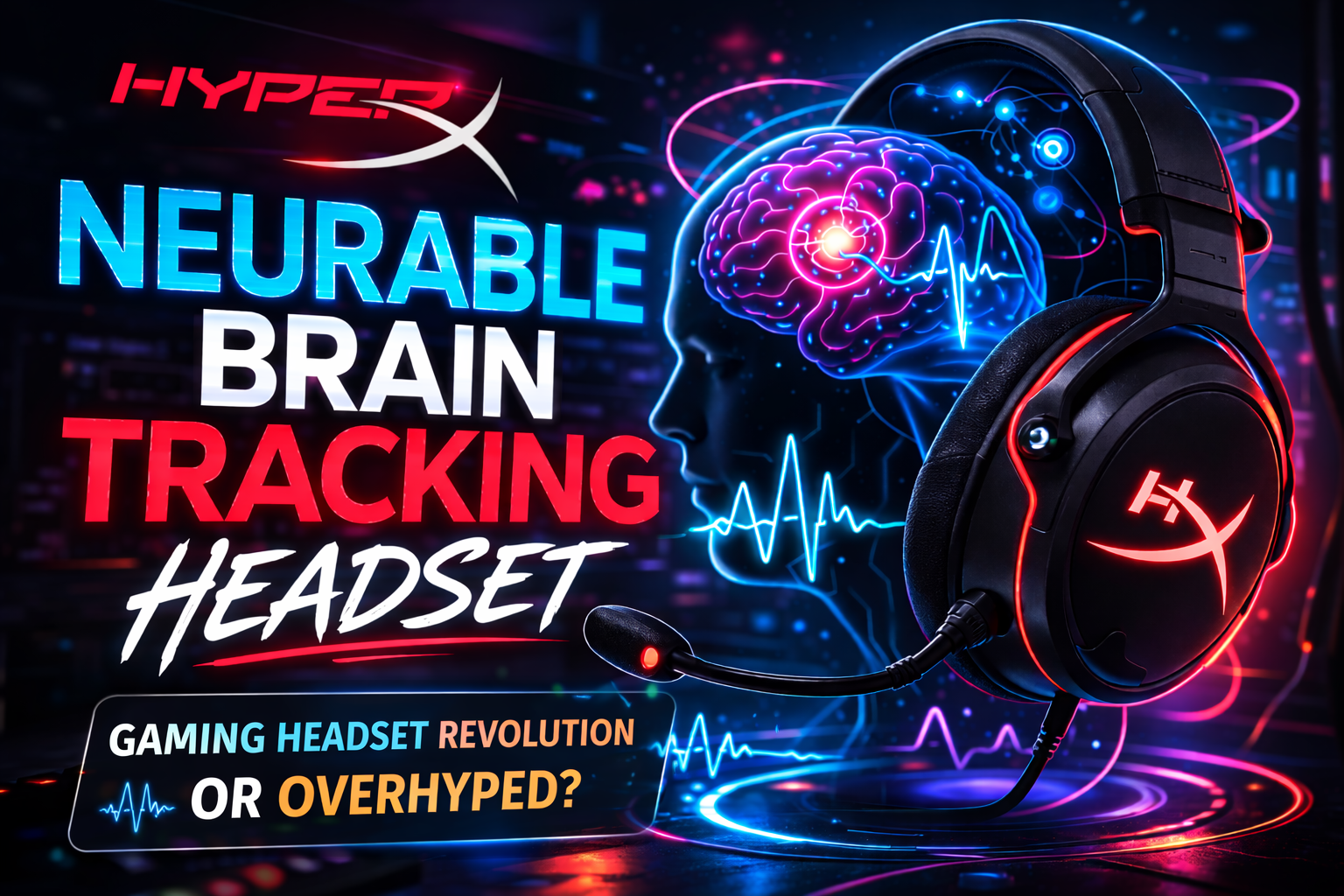
Forget faster refresh rates and lower latency—what if your gaming headset could read your mind? At CES 2026, HyperX and neurotechnology company Neurable unveiled a prototype gaming headset with built-in EEG sensors that track your brain activity in real-time. The goal isn’t to control games with thoughts, but to help you understand your own focus, prevent burnout, and even improve reaction times. This is the first device of its kind, and it could change how we think about gaming performance .
Quick Overview: HyperX Neurable Brain-Tracking Headset
| Feature | Details |
|---|---|
| Technology | Non-invasive EEG sensors in earcups |
| Key Features | Prime neurofeedback system, Broadcast live metrics |
| Performance Gain | Up to 43ms faster reaction time (everyday gamers) |
| Accuracy Improvement | 0.53% for casual, nearly 3% for pro players |
| Target Audience | Competitive gamers, esports athletes, streamers |
| Release Date | Not announced (prototype only) |
| Price | Not announced |
What Is the HyperX Neurable Headset?
The HyperX Neurable headset is a brain-computer interface (BCI) built into a familiar gaming form factor. Inside the thick, comfortable earcups are EEG sensors designed to read brain signals in real-time without requiring gel caps, wires, or intrusive headgear .
This technology was originally developed in academic settings and tested with the Department of Defense for monitoring brain health after blast exposure. Now, thanks to advances in AI-driven signal processing and sensor miniaturization, it’s being adapted for gamers .
The headset doesn’t read your thoughts—it tracks cognitive states: focus, mental fatigue, and cognitive readiness . Think of it as a fitness tracker for your brain, but instead of steps and heart rate, you get metrics like “cognitive speed” and “brain battery” .
How Does It Work?
The EEG Sensors
Electroencephalography (EEG) measures the tiny electrical signals produced by neurons in your brain. Neurable’s innovation is placing these sensors inside the earcups, where they lightly touch the skin around your ears . The sensors are concealed within thick fabric padding, so the headset doesn’t look like medical equipment .
Real-Time Signal Processing
Those raw brain signals are processed instantly by AI models trained to identify patterns linked to focus, distraction, and cognitive load. As you play, the system visualizes your mental state—when you focus, a graph line rises; when you get distracted, it falls .
The Two Core Features
Prime: Cognitive Warm-Up for Your Brain
Prime is Neurable’s neurofeedback system, best described as a personalized meditation warm-up tailored for gamers . Before a match, you spend 30 seconds to a few minutes watching a visualization of your brain state—swirling dots that slowly collapse into a single point as you relax and concentrate . The result? You enter the game feeling oddly alert and ready, similar to the feeling after a good meditation session but with a clearer sense of purpose .
Broadcast: Live Cognitive Metrics
During gameplay, Broadcast overlays your brain data onto your screen or stream. You can see:
-
Cognitive speed: A “speedometer” measuring your concentration and focus levels
-
Brain battery: A health bar that decreases as you become mentally fatigued, alerting you when it’s time to take a break
For streamers and esports athletes, these metrics could be displayed live, letting viewers see the real-time mental focus of players during intense matches .
The Performance Data: Does It Actually Work?
Neurable conducted preliminary studies with both everyday gamers and semi-professional esports athletes. The results are impressive :
| Player Group | Reaction Time Improvement | Accuracy Improvement | Additional Targets Hit |
|---|---|---|---|
| Everyday Gamers | 43ms faster | +0.53% | +9 targets |
| Collegiate/Pro Players | 38ms faster | +3% | +21 targets |
A Mashable reporter who tested the headset at CES 2026 described the experience: after going through the Prime warm-up, his reaction time dropped from roughly 500 milliseconds to the mid-450s, and he hit more targets despite struggling with contact lenses during the demo . The feeling afterward? “Everything on screen felt slightly slower, but I was reacting more quickly. [Neurable CEO] described it as ‘bullet time for your brain,’ which sounds corny until you experience it” .
SoundGuys also tested the prototype and reported similar results: after Prime, reaction time was “almost cut in half” and they set a new high score in the aiming test .
Why This Matters for Competitive Gaming
In competitive gaming, sustained concentration often matters more than raw mechanical skill . A tool that tells players when their mental performance is slipping could help with:
| Benefit | Description |
|---|---|
| Prevention of “tilt” | Recognize when frustration is affecting your play before it spirals |
| Burnout prevention | Get alerts when your brain battery is low and you need a break |
| Practice efficiency | Ensure you’re practicing with maximum focus (“good practice, not crap practice”) |
| Performance insights | Understand why some sessions feel better than others |
For professional esports teams, this kind of cognitive data could eventually become as valuable as physical training metrics are in traditional sports .
Privacy and Ethical Considerations
Brain data is highly sensitive. Questions about how it’s collected, stored, processed, and who has access to it will need clear answers before this technology goes mainstream . Neurable hasn’t detailed their privacy framework yet, but this will be crucial for consumer trust.
When Can You Buy It?
Important: This is still a prototype. There is no confirmed release date, price, or final product name . HyperX and Neurable have announced a development partnership, not a product launch. The companies have high expectations to bring this headset to market “in the very near future,” but for now, it remains a proof of concept .
The Bigger Picture: Brain-Tracking as the Next Wearable Frontier
The gaming wearables market is projected to grow from $5 billion today to nearly $20 billion by 2034 . Neurable is positioning brain-tracking as the next major category after heart rate monitors and sleep trackers .
If successful, this technology could make cognitive metrics as routine as tracking frame rates or input latency . The question is whether gamers will pay a premium for insights into their own minds.
Frequently Asked Questions
What is the HyperX Neurable headset?
It’s a prototype gaming headset developed by HyperX and Neurable that uses EEG sensors in the earcups to track brain activity in real-time, measuring focus, cognitive load, and mental fatigue during gameplay .
Can it read my thoughts?
No. The headset doesn’t read thoughts—it tracks cognitive states like focus and fatigue. It measures electrical signals from neurons and interprets patterns related to attention, not specific thoughts .
How much faster does it make you?
In Neurable’s studies, everyday gamers improved reaction times by an average of 43 milliseconds. Collegiate and pro players improved by 38 milliseconds .
When will it be released?
No release date has been announced. The device shown at CES 2026 is a prototype, and the companies have not confirmed pricing or availability .
How much will it cost?
Pricing has not been announced. For reference, Neurable’s previous MW75 Neuro headphones with Master & Dynamic cost around $700 .
Is this the same as Neuralink?
No. Neuralink develops invasive brain implants for medical applications. The HyperX Neurable headset is non-invasive—it uses external sensors, like a fitness tracker for your brain .
What games will it work with?
Initially, it will work with aim trainers and FPS games for training purposes. Integration with specific titles hasn’t been announced .
The Bottom Line
The HyperX Neurable brain-tracking headset is one of the most fascinating innovations to come out of CES 2026. The technology is real, the early data is promising, and the potential applications for competitive gaming are significant.
But this is still the very beginning. There’s no product to buy yet, no price tag, and many questions remain about real-world effectiveness and privacy.
What’s exciting is the direction: gaming peripherals are no longer content with responding to your hands and voice. They’re beginning to understand your mind.
HyperX and Neurable officially unveiled their partnership at CES 2026 in Las Vegas, with the full announcement available on Businesswire
While the Neurable prototype represents the future of gaming audio, HyperX’s current lineup already delivers exceptional sound quality. For a deep dive on their latest releases, check out our Best HyperX Headset in 2026 — Cloud 2, Cloud 3 & Cloud Alpha – GameZHaven