Disclosure: This article may contain affiliate links. We may earn a commission at no additional cost to you.
Table of Contents
ToggleWhat Is a Rapid Trigger Keyboard? 2026 Guide
If you follow gaming hardware, you’ve likely heard the term Rapid Trigger thrown around — and for good reason. Hall‑effect keyboards with Rapid Trigger are reshaping what a fast keyboard can do, and in 2026 the tech is finally showing up in affordable models. This guide explains exactly what a rapid trigger keyboard is, how it works, and why so many competitive players are switching. It’s for budget‑conscious gamers, first‑time mechanical keyboard buyers, and anyone who wants the facts before spending money. No hype, just what matters when every millisecond counts.
| Model | Key Spec | Best For | Approx Price (USD/CAD) |
|---|---|---|---|
| Redragon K617 Hall Effect | 60% layout, adjustable actuation, Rapid Trigger firmware | Budget competitive FPS | ~$45 USD / ~$60 CAD |
| Attack Shark K86 | Tenkeyless, pre‑lubed Hall‑effect switches, per‑key sensitivity | All‑round competitive gaming | ~$70 USD / ~$95 CAD |
| Royal Kludge RK61 Hall Effect | 60% wireless, actuation range 0.5–3.8 mm, dedicated Rapid Trigger toggle | Wireless competitive play | ~$55 USD / ~$75 CAD |
What Is a Rapid Trigger Keyboard?
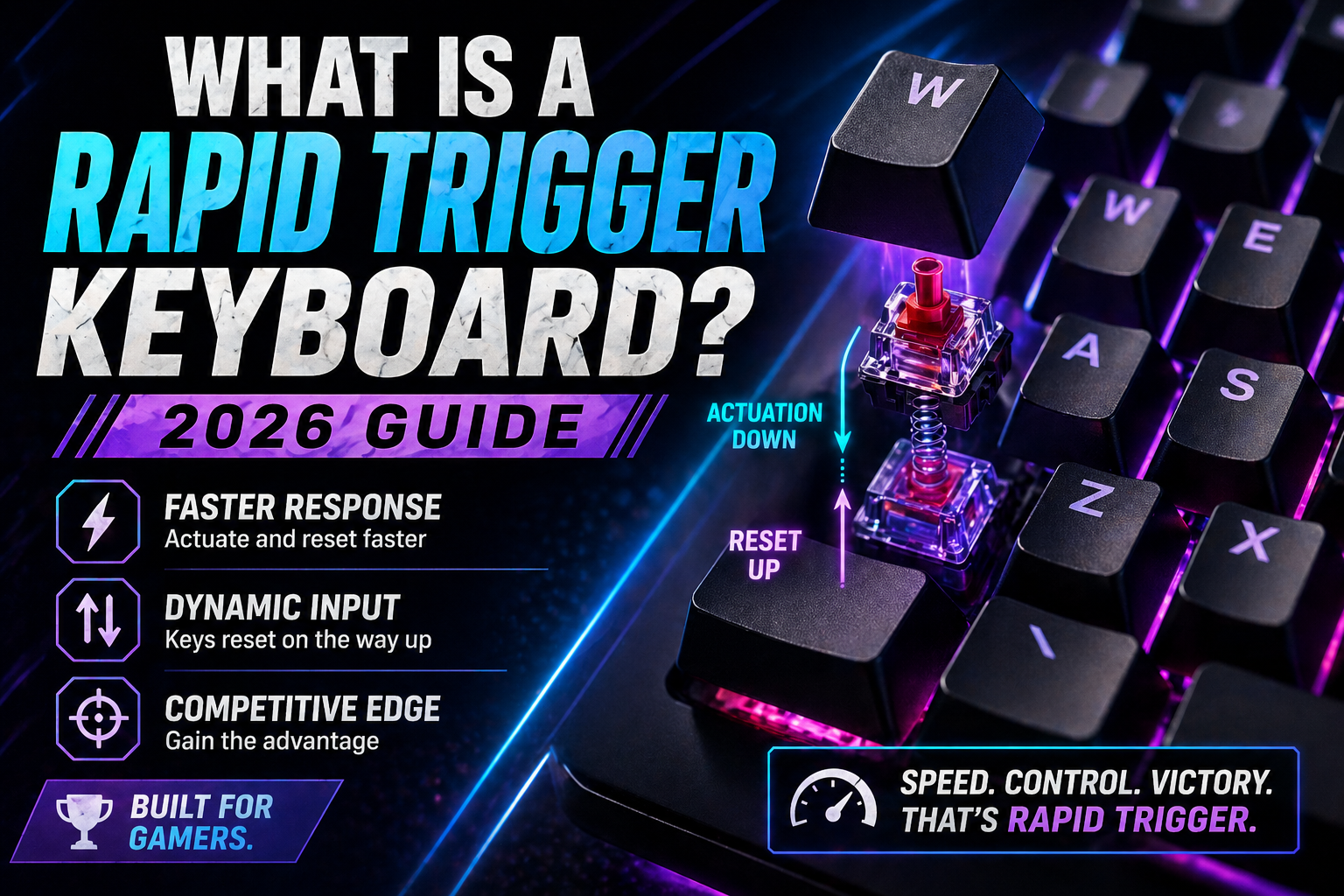
Rapid Trigger is a feature built on Hall‑effect switches. A standard mechanical keyboard registers a keystroke when the switch crosses a fixed physical actuation point — usually near 2 mm — and resets only when the key rises back above that same spot. Rapid Trigger removes that fixed reset distance completely. The instant the key starts moving upward, the input stops. That lets you reactivate the key without waiting for it to travel all the way back. In practical terms, you can fire a second shot, change direction, or counter‑strafe faster because the board isn’t locked into a mechanical release cycle.
Hall‑effect sensors track the exact magnet position inside each switch in real time. The firmware knows continuously how deep a key is pressed. Rapid Trigger tells the board to cut the signal the moment upward motion is detected — even if the key has barely lifted by 0.1 mm. That dynamic reset point is what makes the technology fundamentally different from any traditional mechanical switch, and it’s why Rapid Trigger is dominating competitive gaming conversations in 2026.
How Rapid Trigger Differs from Mechanical Switches
A conventional mechanical switch — Cherry MX Red, Gateron Yellow, or any budget clone — has a fixed actuation and reset point baked into its design. You press down roughly 2 mm to actuate, and the key must rise back to about 1.5 mm before the circuit breaks and a new press can be registered. That gap between actuation and reset (hysteresis) is unavoidable with metal leaf contacts.
Rapid Trigger replaces physical contacts with magnetic sensing and software‑defined thresholds. The board can be programmed so actuation happens at 1.0 mm of travel, and reset happens the instant the key reverses direction by even 0.1 mm. No mandatory up‑stroke distance. For rapid double‑taps, quick peeks in tactical shooters, or fast rhythm inputs, this removes the mechanical latency competitive players have fought against for years. The keyboard feels more responsive not because of polling rate alone, but because the input logic itself is faster.
Why It Matters for Competitive Gaming
In fast‑paced games — Valorant, Counter‑Strike 2, Apex Legends, Fortnite — movement and shooting are often separated by fractions of a second. Mechanical keyboards create a small but real dead zone during key release that limits counter‑strafing and direction changes. Rapid Trigger cuts that dead zone close to zero, giving a measurable advantage in input responsiveness. Pro players have shown quicker peek timings with Hall‑effect boards, and tournament organizers confirm the tech is legal.
There’s also a strong budget argument: Rapid Trigger now delivers near‑zero reset behaviour in sub‑$70 keyboards. You no longer need a $200+ flagship to feel the difference. And if you want a clearer picture of how other specs affect your aim, our guide on mouse DPI breaks that down without the marketing fluff.
Adjustable Actuation vs. Rapid Trigger
These two features often appear together but are not the same thing. Adjustable actuation lets you set the travel distance at which a key press registers — for example, 1.0 mm instead of 2.0 mm — making the keystroke feel shorter or longer. Rapid Trigger controls the reset behaviour, not the actuation point. A keyboard can have adjustable actuation without Rapid Trigger (some early Hall‑effect boards did), but competitive‑grade implementations almost always include both because they complement each other. If a cheap board advertises “adjustable actuation,” don’t assume it has true Rapid Trigger without checking the firmware specs.
Do You Need a Rapid Trigger Keyboard Right Now?
Rapid Trigger helps most if you’re a ranked FPS player or rhythm‑game enthusiast who benefits from ultra‑fast key taps and instant direction changes. For casual MMO players, students writing essays, or parents buying a reliable home keyboard, the benefit is minimal. A good standard mechanical board will feel great and last for years. If you grind tactical shooters or battle royales daily, a Rapid Trigger board gives a genuine responsiveness edge — especially at today’s budget prices. If you mostly play single‑player games or use your PC for work, there’s no rush. Match the tech to your real use case, not the hype.
Budget Rapid Trigger Keyboards Available Now
Affordable Hall‑effect models with proper Rapid Trigger firmware are here. Below are three solid starting points that balance price and performance.
Redragon K617 Hall Effect — ~$45 USD / ~$60 CAD. Compact 60% layout, magnetic switches with per‑key adjustable actuation, and a Rapid Trigger mode accessible via Redragon’s software. A no‑frills entry point for competitive FPS players on a strict budget.
Attack Shark K86 — ~$70 USD / ~$95 CAD. Tenkeyless design, pre‑lubed Hall‑effect switches, and dedicated Rapid Trigger firmware with per‑key sensitivity control. If you’re already familiar with Attack Shark from our Attack Shark X3 review, you’ll recognize the same focus on value.
Royal Kludge RK61 Hall Effect — ~$55 USD / ~$75 CAD. 60% wireless board, magnetic switches with an actuation range of 0.5–3.8 mm, and a reliable Rapid Trigger toggle. Good for wireless competitive play without breaking into triple‑digit pricing.
Prices are approximate. Check current listings before buying, as budget stock moves quickly.
Buyer’s Guide: How to Choose
Focus on a handful of real‑world specs, not marketing claims. Look for a wide actuation adjustment range — 0.5–3.8 mm gives meaningful control; a narrow 1.5–2.5 mm range is limiting. Confirm that Rapid Trigger is a firmware feature with a dedicated toggle and per‑key settings, not a vague “fast actuation” line. A 1000 Hz USB polling rate matters so the computer receives instant state changes. Software quality varies at budget prices, so check reviews that discuss installation, key‑binding, and profile saving. Build quality still counts: hot‑swappable sockets are a bonus if you want to experiment later, and avoid boards with heavy ping or stabilizer rattle unless you’re willing to mod. Finally, check the warranty and return policy — Hall‑effect boards have proven reliable so far, but early‑adopter budget models can have occasional firmware quirks.
Frequently Asked Questions
Is Rapid Trigger good for typing?
It can be, but most typists won’t notice a big advantage. The main benefit is for repetitive, rapid keypresses in gaming. For long‑form typing, a comfortable mechanical switch weight often matters more than a magnetic reset curve.
Does Rapid Trigger work on any keyboard?
No. Rapid Trigger requires Hall‑effect (magnetic) switches and compatible firmware. It cannot be added to a standard mechanical keyboard through a software update.
Can you use Rapid Trigger in Valorant?
Yes. Rapid Trigger is allowed in Valorant and other competitive shooters. The feature improves physical responsiveness and does not automate inputs or violate tournament rules.
Is Hall Effect better than mechanical?
Better depends on the use case. For maximum responsiveness and custom actuation, Hall‑effect switches have the edge. Mechanical switches offer a wider variety of feels and sound profiles at lower prices, and they’re perfectly fine for non‑competitive players.
What’s the cheapest Rapid Trigger keyboard right now?
As of early 2026, several models sit around $45–55 USD. Prices change often, so check current listings for the Redragon K617 Hall Effect and Royal Kludge RK61 Hall Effect as solid budget starting points.
Do I need Rapid Trigger for casual gaming?
No. Unless milliseconds directly influence outcomes in your games, a standard mechanical keyboard works great and usually costs less. Rapid Trigger is a performance upgrade, not a requirement.
If you’re still dialling in your aim, our polling rate guide breaks mouse speed down for you.